

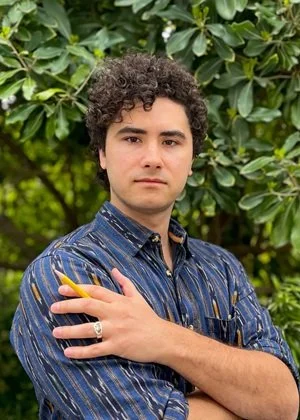
P. C. Verrone
Are we getting better or worse in taking care of our forests? In adopting new pest control technologies, are we forgetting what we once knew? In his compelling new play THE FORESTER, P. C. Verrone reimagines the life and work of his grandfather, Dr. Carroll B. Williams Jr. (1929–2024), a pioneering entomologist and forester who challenged the standard practices of forest management during his time – and suffered the consequences. From the woods of Oregon to the halls of Yale, the play explores Williams’s decades-long fight to unite his Black and Indigenous worldview with his scientific work to preserve America’s pine forests.
THE FORESTER will have its first public reading on Thursday, May 21 at 3:00 PM at the Ensemble Studio Theatre as part of the Spring 2026 EST/Sloan First Light Festival. You can register for this free reading at this link.
We needled P. C. with questions. He sprouted evergreen answers.
(Interview by Rich Kelley)
What inspired you to write THE FORESTER?
I have been wanting to write about my grandpa for a while. To me, he was this formidable but incredibly caring man who would take me on hikes around his home in the Berkeley Hills. After he passed away, I helped my family go through his documents, and that was the first time I got a sense of him as a scientist. That was also the first time we saw the extent of the obstacles he had to overcome as a Black man in his field. So, this play is my attempt at capturing his complexity and dramatizing many of the ideas that he wrote about, some of which he never got a chance to publish.
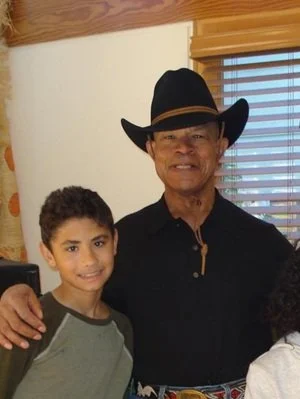
P. C. Verrone and his grandfather in 2007 / Courtesy of family of Carroll Williams
Why this play? Why now?
This play becomes more relevant each day, in ways that are both exciting and disheartening. There are growing partnerships between the Forest Service and indigenous communities like the Great Sioux Nation. At the same time, the current administration is dismantling the Forest Service’s ability to protect the environment and is instead weaponizing it against people and the natural world. A question at the heart of this play is: how do we keep from becoming paralyzed by hopelessness when the world is on fire?
In your play you put four actors on stage as different versions of the main character, Carroll Williams, at different ages. Why?
I always imagined that this play would be performed by a kind of ensemble of trees. It allowed me to put him in conversation with himself, challenge some views that he may have held as a young man but later learned from. He became able to comment on these previous “eras” of himself.
How is a “memory play” different?
Memory plays have a surreal, speculative aspect to them because memory is fallible, and therefore there’s a sense that what’s being performed may not be factually accurate. In his later years, my grandpa retold a lot of stories of his life, and through these retellings, some details would disappear and new ones emerged. His mind would move across time fluidly rather than linearly. To a certain extent, I want this play to reflect the experience of him telling a story.
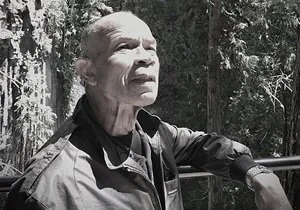
Carroll Williams visiting a redwood grove in Berkeley, CA, 2022 / Courtesy of family of Carroll Williams
Williams is celebrated as being “the first African American who” in so many areas: the first to serve in an integrated unit with the Marines in the Korean War, the first to get a Ph.D. in forestry and entomology, the first to get hired by the U.S. Forest Service. How important do you think his Kiowa and Osage heritage was to him – and to you?
It was incredibly important to him, and crucial to the way that he understood himself. When I was growing up, he would tell us grandkids about Kiowa and Osage history, particularly how these tribes interacted with Black people moving west, which was really the story of our ancestors. His approach to forestry was greatly informed by Indigenous American knowledge, and that felt necessary to represent in this play. It’s also important to me because there is so little representation of Afro-Native experiences. I want to show the beauty in embracing the confluence of Black and Native approaches to the natural world.
When did you first know you were a playwright? What writers have influenced you the most?
I’ve been involved with theater since I was a kid and almost immediately became interested in writing my own skits and short plays. I started to see playwriting as a possible career in college when I had some opportunities to get involved in the new play development process, and I just fell in love. Some of the writers who have hugely influenced my work include Yolanda Bonnell, Naomi Iizuka, Brandon Jacobs-Jenkins, Tony Kushner, and Lester Mayers.
You write fiction as well as plays. What leads you to decide to turn a subject into a play rather than a short story or novel?
This is a great question! Sometimes, I will start to write an idea as a short story or a novel only to realize it works better as a play, and vice versa. What excites me most about playwriting is creating amazing theatrical moments. If there is a moment like that in a story, one that has to be seen and won’t satisfy me only living in a reader’s imagination, then it has to become a play.
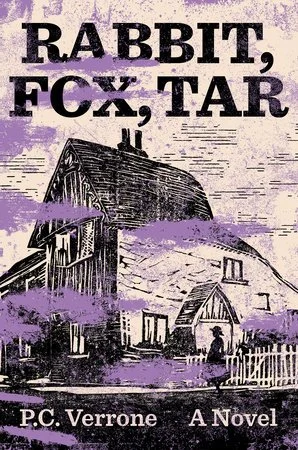
What’s next for P. C. Verrone?
My debut novel Rabbit, Fox, Tar will be published in June, and I’m looking forward to going on a small book tour to celebrate that. In August, Santa Fe Playhouse will be producing the world premiere of my play Bad Medicine. A Native Voices production in Los Angeles will follow soon after. I’m also co-editing a speculative fiction anthology by Black writers called The Cookout. Somewhere in there I hope to find time to sleep.
THE FORESTER is one of the readings of new plays in development as part of the EST/Sloan Project in the Spring 2026 First Light Festival. The festival is made possible through the alliance between the Ensemble Studio Theatre and The Alfred P. Sloan Foundation.

