

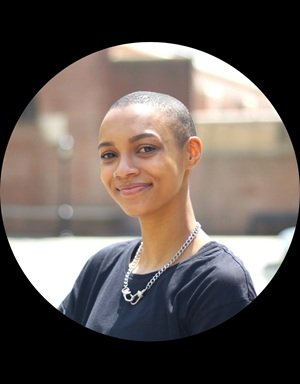
Mikaela Berry
What drives high-energy high-school high-achievers to compete in stressful academic decathlon contests? A better college resume? Ego? Hormones? In her new play SUPERQUIZ! playwright Mikaela Berry follows the exciting, sometimes confusing, and extremely nerdy road to victory of an academic decathlon team of tenacious teenagers in Harlem.
SUPERQUIZ! had its first public reading on Thursday, December 11 at the Ensemble Studio Theatre as part of the Fall 2025/Winter 2026 EST/Sloan First Light Festival.
We challenged Mikaela with questions. The outcome: another gold medal interview.
(Interview by Rich Kelley)
What inspired you to write SUPERQUIZ!?
My own life! I did academic decathlon in high school, and it was such a fun (and extremely nerdy) experience. I began thinking about plays about the high school experience and sought to create as realistic high school-aged characters as possible, drawing on years of experience working with high school students. I wanted to honor their lives and multifacetedness in ways that felt authentic and organic.
How closely does the team in the play resemble the one you were on? What was your strongest subject? Which character do you relate to most? Did your team win?
It’s as close as I could make it! You complete seven tests, give a speech, and an interview, and write an essay in one day; afterward, you compete live as a team in front of an audience. As I recount the studying and work that went into this, I’m trying to remember what exactly was enjoyable about it, but I do remember it being enjoyable. My team was nowhere close to winning, but I did win a gold medal for my interview—and just so happened to receive my medal on the same day I had my interview for Fordham, where I wound up graduating with a degree in Playwriting.
You have four male students and two female students in the play. Why more boys?
I included more boys to showcase and celebrate the complexities of Black boyhood. I wanted to show them being sweet to one another, confronting their anger, and being confused by the business of growing up. It also felt vital for the team to be led by a Black male who was able to serve as a goofy but reliable mentor and inspiration for a bunch of misfits trying to find their way.
Why this play? Why now?
I’d been sitting on this idea for years, and whenever asked about it, I would pitch it in short as “just really smart Black kids.” I wanted a play that wasn’t about police violence or slavery or anyone’s shortcomings or inability to succeed because of their Blackness. I wanted my characters to be focused on college, success, and feeling able to be honest about what bothered them.
What do you hope the audience takes away from watching your play?
That black kids can be nerdy, intelligent, driven, soft, queer— all of the things I have experienced in my own life, but haven’t seen depicted enough on stage.
How did the play evolve as you wrote it?
Oh, so much! I had to write an entire character out around draft three because I realized I was using her as a crutch to provide insight for another character, and I realized there was a better way to do that that wasn’t as obvious. I also have to make my edits by hand between drafts; it helps me visualize the changes more clearly and keep track of my notes more easily. That way, if I want to reorder scenes or track how many times a phrase is repeated, or whether there are any plot holes, I can physically mark and shuffle the pages until things start to look like they make sense.
SUPERQUIZ! had its first public reading on Thursday, December 11, at the Ensemble Studio Theatre. What are your thoughts after the reading?
It was really exciting to hear my work out loud after working on this play for over a year and a half. I was very pleased with the way my cast interpreted the text, which helped me determine how to further strengthen the play.
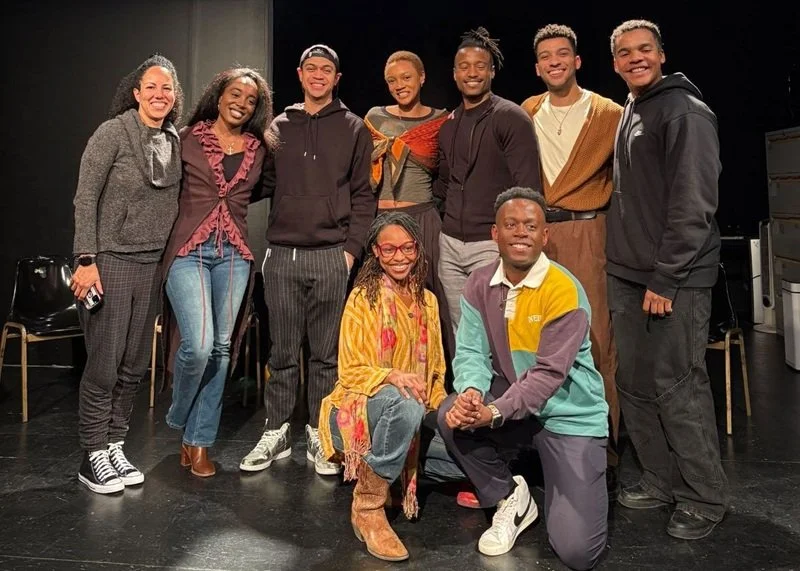
The cast of the 12/11/25 EST/Sloan First Light reading of SUPERQUIZ! From left, director Colette Robert, Jamaica Brewster (Imani), Mason Reeves (Jeremiah), playwright Mikaela Berry, Sheldon Best (Eric Thompson), David Wilson (Tyrell), Reynaldo Piniella (Zamir); in front, Nya Estep (Destiny), Kaisheem Fowler-Bryant (Jonathan). Photo by Clarissa Mota.
I found the late recruit Jonathan to be the most intriguing character. As an outsider, he becomes a change agent on the team. How did he come to be?
All of my characters carry a little bit of high school me in them—but Jonathan was absolutely my favorite character to write. His arc from semi-tough jock to nerdy boy with a soft center was created to highlight all of the different ways a Black boy can be. So often the narrative stops at sports or entertainment, and I wanted to give Jonathan more depth than that. I loved the idea of a basketball player turned nerd—maybe I’ve seen High School Musical one too many times.
What are the positive and negative aspects of high school students participating in something as intense as SUPERQUIZ!?
On the positive side, it teaches you how to take and finish a test within a specific timeframe—something that is useful for students preparing to take the SAT or ACT exams. It also requires teamwork and relying on and celebrating each other’s strengths—not every person competing is going to be perfect in all seven categories, so you need each other when it comes to collective scores! Negatively, there may be burnout or information overload, and of course, the anxiety of performing well under pressure. Additionally, as these students prepare for the academic decathlon, they are also applying to college and navigating various interpersonal stressors. We put a lot of pressure on teenagers!
In addition to being a playwright, you are also a harm reductionist, a restorative justice facilitator, an abolitionist social worker, and a mental health counselor. How have your experiences in these roles influenced your playwriting?
I write what I know, and all my experiences find their way into my work in some way. My recent play SPENT took place in a drop-in center and covered the burnout that comes with working in harm reduction. My bachelor's is in playwriting and African American studies, and my master's is in social work, so there is always some infusion of mental health, race, and class in what I write.
When did you realize you were a playwright?
I was admitted to Fordham for Stage Management and transferred into the playwriting program my sophomore year, becoming the university’s first Black playwright. I was in college at the same time as the uprisings in Ferguson, Missouri, following the murder of Michael Brown, and felt called to write about what I was experiencing and feeling. I remember talking to my roommate about how I wanted to communicate my frustration and pain, and she simply asked, “Why don’t you see if you can transfer into the playwriting department?” I was accepted into the program a few weeks later. But I’ve been writing stories and doing theatre since I was eleven, so storytelling has always been a part of my life.
What's next for Mikaela Berry?
I am currently exploring a two-person play about the relationship between someone who goes to the same escape room alone every month and the employee who runs it. Haven’t decided if it will be funny or creepy yet—it’ll probably be both.
SUPERQUIZ! was one of three readings of new plays in development as part of the EST/Sloan Project in the Fall 2025/Winter 2026 First Light Festival, which ran from November 6, 2025 through January 15, 2026. The festival is made possible through the alliance between the Ensemble Studio Theatre and The Alfred P. Sloan Foundation.

